
A strong Local SEO website needs more than a collection of optimized pages.
Boise local keyword mapping gives service businesses a framework for deciding which searches belong to which pages before content gets created.
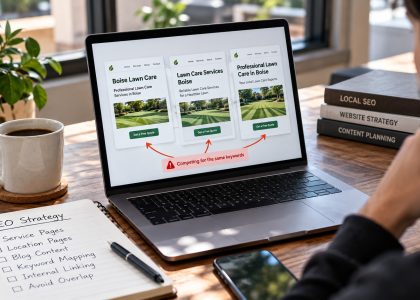
Without that structure, businesses can accidentally create several pages targeting nearly identical searches.
The result can be confusing for customers and search engines.
The objective isn’t to put more keywords on your website. It’s to give every important search a clear destination.
What Is Local Keyword Mapping?
Local keyword mapping is the process of matching relevant searches with specific pages on your website.
Instead of collecting hundreds of keywords in a spreadsheet and randomly inserting them into content, you organize them around:
- Services
- Locations
- Customer problems
- Search intent
- Existing website pages
- Future content opportunities
Each important keyword group should have a logical destination.
For example, a Boise pest control company shouldn’t automatically create separate pages for every slightly different version of “pest control Boise.”
Those searches may belong to the same page.
However, termite control Boise could represent a different service and deserve a dedicated destination.
Why Boise Local Keyword Mapping Matters
Service businesses usually need to rank for more than one search.
A company may provide several services across multiple communities.
That creates combinations such as:
Service + Location
For example:
- Pest control Boise
- Pest control Meridian
- Pest control Eagle
- Termite control Boise
- Termite control Meridian
Without a map, the website can quickly become disorganized.
Keyword mapping helps determine where those searches should lead before pages are written.
Start With the Services That Generate Revenue
Don’t begin by chasing every keyword you can find.
Start with the business.
List your most important services.
For example, a lawn care company might prioritize:
- Lawn maintenance
- Fertilization
- Weed control
- Aeration
- Seasonal cleanup
Then identify how customers search for those services.
This keeps SEO connected to what the company actually sells.
Revenue priorities should influence SEO priorities.
Map Your Primary Service Pages First
Your core service pages form the foundation.
Each should have a clearly defined topic.
For example:
Lawn Fertilization Page
Primary topic: lawn fertilization
Related searches might involve:
- Lawn treatment
- Fertilizer service
- Lawn feeding
- Fertilization company
You don’t necessarily need four different pages.
Those terms may describe the same underlying service.
Grouping them helps create one stronger destination instead of several thin pages.
Add Geographic Intent to the Map
This is where Local SEO becomes more specific.
Legacy Engine’s Local Landing Page Framework uses Service + City pages across a client’s actual market to target high-intent local searches.
Keyword mapping can determine which combinations deserve attention.
A simplified structure could look like:
Service → Boise
Service → Meridian
Service → Eagle
However, don’t create location pages simply because another city exists nearby.
The business should genuinely serve that market.
Don’t Build a Page for Every Keyword Variation
This is one of the most important distinctions.
Consider:
- Boise lawn care
- Lawn care Boise
- Lawn care company Boise
- Boise lawn care services
These phrases may represent essentially the same customer need.
Creating four separate pages would likely be unnecessary.
Instead, map related variations to one useful page.
One intent can support multiple keyword variations.
Prevent Pages From Competing With Each Other
Poor website planning can create overlap.
Imagine you have:
Page A: Boise Pest Control Services
Page B: Best Pest Control Company Boise
Page C: Local Pest Control Boise
If all three pages serve essentially the same purpose, you’re creating unnecessary duplication.
Keyword mapping helps identify that problem before publishing.
Ask:
Does this new page satisfy a genuinely different customer need?
If not, strengthen the existing page instead.
Use Keyword Mapping to Plan Local Landing Pages
Local landing pages become easier to organize when you know:
- Which services matter most
- Which cities you genuinely serve
- Which searches represent meaningful customer intent
- Which pages already exist
- Which combinations are missing
You can then build a matrix.
| Service | Boise | Meridian | Eagle |
|---|---|---|---|
| Core Service A | Existing | Needed | Existing |
| Core Service B | Needed | Needed | Existing |
| Core Service C | Existing | Existing | Needed |
This turns Local SEO expansion into a planned framework.
Instead of randomly adding pages, you can see exactly where opportunities exist.
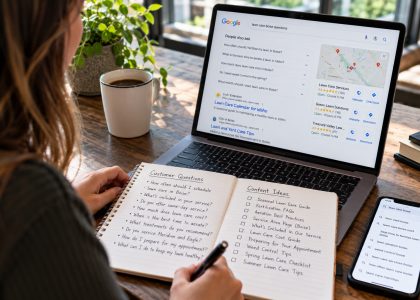
Use Keyword Mapping for Blog Content Too
Not every search should lead to a commercial landing page.
Some people are still researching.
They might ask:
- How does the service work?
- How much does it cost?
- When is the service needed?
- What causes the problem?
- Can I solve it myself?
- What should I expect?
Those searches may be better suited for educational content.
Legacy Engine’s service model includes weekly SEO content built around search intent, making this distinction especially relevant.
Separate Commercial and Informational Keywords
Imagine a Boise pool service company.
Someone searching:
“pool cleaning Boise”
may be looking for a provider.
Someone searching:
“why is my pool water cloudy?”
is looking for information.
Both searches could eventually generate business.
But they shouldn’t necessarily lead to the same page.
A better structure could be:
Informational Search → Blog → Pool Cleaning Service → Boise Landing Page → Contact
Now each page has a defined role.
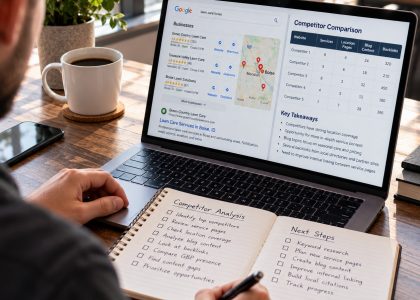
Find Missing Pages Before Creating New Content
Keyword mapping can also reveal gaps.
Suppose an important service generates revenue, but your website barely mentions it.
That’s a gap.
Or perhaps you serve Meridian but have no useful page explaining that service availability.
Another gap.
This makes the keyword map a planning tool.
It can show:
- Existing coverage
- Missing service pages
- Missing local pages
- Supporting content opportunities
- Overlapping pages
- Internal linking opportunities
Connect the Map With Internal Linking
Once keywords have destinations, internal linking becomes more intentional.
A blog about a specific customer problem can link to the corresponding service.
The service page can connect to appropriate location pages.
Related educational content can support the same topic cluster.
The structure becomes:
Customer Question → Blog → Service → Local Page → Conversion
That’s more useful than linking pages together randomly.
Update the Map as Your Business Changes
Keyword mapping isn’t a one-time exercise.
Service businesses change.
You may:
- Add services
- Remove services
- Enter new markets
- Publish new content
- Discover new customer questions
- Change revenue priorities
Your SEO architecture should evolve with the business.
Review the map periodically and compare it against your current website.
Don’t Measure the Strategy by Rankings Alone
A keyword map can organize your SEO strategy.
However, ranking for keywords isn’t the final objective.
Monitor whether important pages generate:
- Qualified organic traffic
- Phone calls
- Estimate requests
- Form submissions
- Service inquiries
- New customers
A keyword that looks impressive in a ranking report may contribute very little revenue.
Meanwhile, a lower-volume local search could produce valuable customers.
Search volume tells you how often people search. Business outcomes tell you whether the traffic matters.
How Legacy Engine Uses a Connected Local SEO Framework
Legacy Engine’s current service model combines four major Local SEO components:
- Google Business Profile Optimization
- Local Landing Page Framework
- Link Building & Citations
- Weekly SEO Content Publishing
Keyword mapping naturally supports that structure.
It helps determine which service and location opportunities deserve pages while separating those searches from informational topics better suited for ongoing content.
That creates a clearer SEO architecture before content production begins.
Learn more About Legacy Engine and its Local SEO system for service-based businesses.
Give Every Important Search a Destination
Don’t build your Local SEO website one random keyword at a time.
Map the structure.
Define your services.
Identify your real markets.
Group related searches.
Separate commercial intent from informational intent.
Then create pages where genuine gaps exist.
A stronger Local SEO system starts by knowing exactly where each search should lead.
Ready to build a clearer Local SEO framework for your service business? Contact Us to connect with Legacy Engine.
Frequently Asked Questions
What is Boise local keyword mapping?
Boise local keyword mapping organizes relevant local searches and assigns them to appropriate service pages, location pages, or supporting content.
Does every local keyword need its own page?
No. Closely related keyword variations often belong on the same page when they represent the same search intent.
How does keyword mapping help local landing pages?
It helps identify meaningful Service + City combinations while reducing unnecessary or overlapping location pages.
Can keyword mapping help prevent duplicate SEO content?
Yes. Mapping makes it easier to identify when multiple pages are targeting essentially the same search before creating additional content.
Should blog keywords and service keywords be separated?
Often, yes. Commercial searches usually belong on service or local landing pages, while informational searches may be better addressed through educational content.