Local service businesses do not always operate from a storefront.
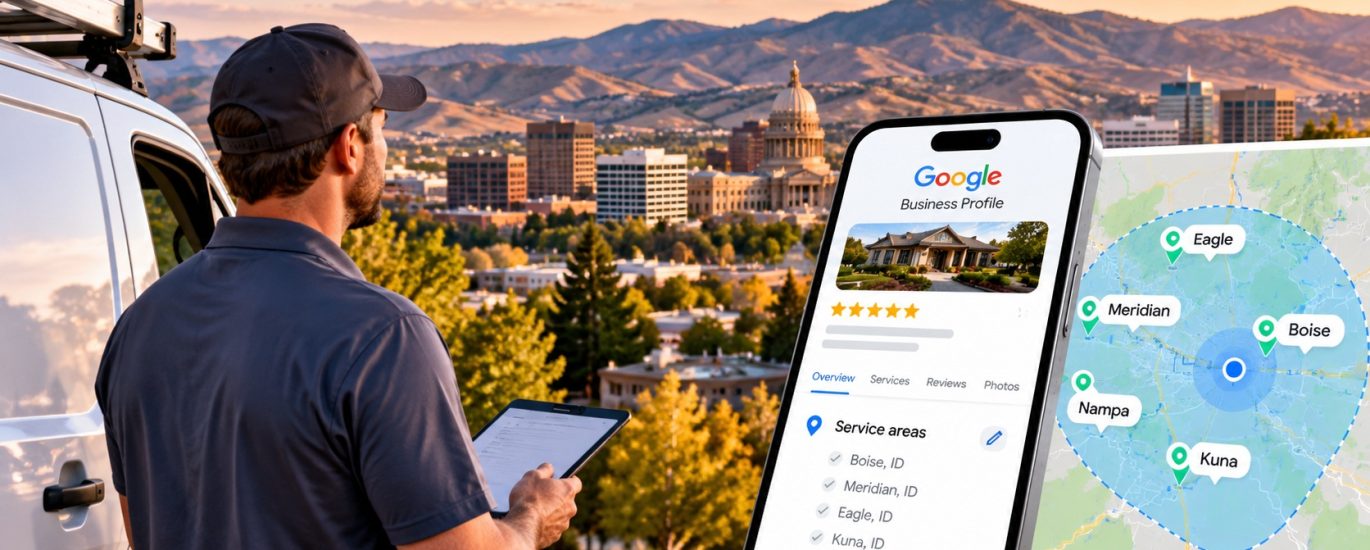
Many travel directly to customers. That makes your Boise Google Business Profile service area an important part of keeping your business information clear and accurate.
For plumbers, landscapers, pest control companies, dog trainers, pool services, and other mobile businesses, your profile should reflect where you actually provide service.
Your service area should represent your real business operations, not every market you want to rank in.
What Is a Google Business Profile Service Area?
A service area tells customers which geographic areas your business serves.
This can be especially useful for businesses that travel to customers instead of serving everyone at a physical storefront.
For example, a Boise service business might work with customers in Boise and selected surrounding communities.
Your profile should represent that accurately.
The goal is simple:
Help customers understand whether your business serves their location.
Who Should Use Google Business Profile Service Areas?
Service areas are particularly relevant to businesses that perform work at customer locations.
That can include:
- Lawn care companies
- Pest control businesses
- Cleaning services
- HVAC companies
- Plumbers
- Electricians
- Mobile pet services
- Contractors
- Pool service companies
- Other home service providers
However, every business operates differently.
Your Google Business Profile setup should reflect how customers actually interact with your company.
Your Boise Google Business Profile Service Area Should Be Accurate
It can be tempting to add every nearby city.
More locations may appear to create more opportunities.
However, your service area should represent places where you genuinely provide service.
Ask practical questions:
- Do we regularly accept customers there?
- Can our team reasonably travel there?
- Does the area fit our normal operations?
- Are we actively trying to serve customers there?
- Can we provide the same level of service there?
If the answer is no, reconsider whether the location belongs in your profile.
Your service area should follow your business model, not wishful thinking.
Don’t Confuse Service Areas With Local Landing Pages
A Google Business Profile service area and a website service area page are different things.
Your Google Business Profile communicates basic information about where you operate.
A local landing page gives your website room to explain a specific service and geographic market in greater detail.
For example, a local page can explain:
- The service offered
- Who needs the service
- Local customer concerns
- Geographic availability
- Frequently asked questions
- How to contact the business
Legacy Engine’s Local Landing Page Framework uses Service + City pages to build website content around genuine service and geographic opportunities.
The two strategies can support each other, but they should not be treated as the same thing.
Don’t Add Locations You Don’t Actually Serve
Local SEO should reflect the real business.
Adding locations simply because they are near Boise can create problems for customers.
Someone may discover your company, contact you, and then learn you do not serve their location.
That wastes their time and yours.
Instead, build your geographic presence around markets your company can actually support.
Accuracy creates a better customer experience.
Think About Your Real Travel Radius
Service businesses should understand how far their teams can realistically travel.
A larger service area is not automatically better.
Long travel distances can affect:
- Scheduling
- Fuel costs
- Employee time
- Appointment availability
- Response times
- Profitability
Your Local SEO strategy should support the business you actually want to operate.
If a location consistently creates poor-fit leads, it may not belong in your geographic strategy.
Review Your Service Area as the Business Grows
Service areas can change.
A company may add employees.
It may open another location.
A new service vehicle could increase capacity.
The company may also stop serving certain markets.
When operations change, review your Google Business Profile.
Check whether your listed service areas still match reality.
This keeps your online presence aligned with the business.
Keep Your Website and Google Profile Aligned
Customers may move from Google to your website before contacting you.
The geographic information they find should make sense.
If your Google Business Profile suggests you serve an area but your website says something different, customers may become confused.
Review geographic information across:
- Your Google Business Profile
- Main website
- Service pages
- Local landing pages
- Contact page
- Important business listings
These pages do not need identical wording.
They should, however, describe the same real-world business.
Build Local Pages Around Real Markets
If a city is an important part of your service area, your website may need useful content for customers in that market.
This does not mean creating dozens of nearly identical pages.
A useful local page should have a reason to exist.
It should clearly explain the service and help customers understand whether the business can solve their problem.
Local pages should provide value, not simply swap one city name for another.
That principle is central to a stronger Local SEO structure.
Service Areas Should Support the Customer Journey
Think about the process from the customer’s perspective.
Someone searches for a service.
They find your business.
They review your profile.
They visit your website.
They check whether you serve their location.
Then they decide whether to contact you.
That journey should feel consistent.
A simple path might look like:
Local Search → Google Business Profile → Relevant Service Page → Contact
Each step should answer the next customer question.
Review Your Service Areas After Operational Changes
Certain business changes should trigger an immediate review.
Check your service areas when you:
- Expand into a new city
- Stop serving an area
- Add a new location
- Increase your service capacity
- Change your business model
- Restructure routes or territories
- Add or remove major services
Don’t leave outdated geographic information online.
Build the review into your operational process.
Avoid Treating Service Areas as a Ranking Shortcut
Your Google Business Profile should accurately describe your company.
Service area settings should not be treated as a shortcut for appearing everywhere around Boise.
Local visibility depends on a broader set of factors.
That is why Legacy Engine approaches Google Business Profile Optimization as part of a larger Local SEO system.
The profile is one piece.
Your website, local pages, citations, links, and ongoing content also contribute to the overall local presence.
Connect Service Areas With Your Local SEO Strategy
A strong geographic strategy should connect multiple parts of your online presence.
Legacy Engine’s Local SEO system includes:
- Google Business Profile Optimization
- Local Landing Page Framework
- Link Building & Citations
- Weekly SEO Content Publishing
These pieces have different jobs.
Your Google Business Profile communicates important local business information.
Local landing pages provide deeper service and geographic information.
Citations help maintain your broader local presence.
SEO content creates additional opportunities to answer customer searches.
The goal is to build one connected Local SEO system around the markets your business actually serves.
Create a Simple Service Area Review Process
You don’t need to constantly change your service areas.
You do need to keep them accurate.
Use a simple review process:
Step 1: Review your current service areas.
Step 2: Compare them with where your team actually works.
Step 3: Identify areas you no longer serve.
Step 4: Confirm any new markets your business has entered.
Step 5: Review your website for geographic consistency.
Step 6: Update other important listings when necessary.
A simple system makes ongoing maintenance easier.
Build Local Visibility Around Where You Actually Work
Your service area should reflect your real business.
Start with the markets you genuinely serve.
Keep the information accurate.
Connect those markets with useful website content.
Review your setup when operations change.
Then support everything with a broader Local SEO strategy.
For Boise service businesses, that creates a more useful foundation than simply trying to appear in as many cities as possible.
Build your local presence around real customers, real services, and real markets.
Learn more About Legacy Engine and its Local SEO system for service-based businesses.
Ready to strengthen your local search presence? Contact Us to connect with Legacy Engine.
Frequently Asked Questions
What is a Google Business Profile service area?
A service area helps communicate the geographic areas where a business provides services to customers.
Should I add every city near Boise to my service area?
Your service areas should reflect locations where your business genuinely provides service. Avoid adding locations simply because you want more local visibility.
Is a Google Business Profile service area the same as a service area page?
No. A Google Business Profile service area is part of your business profile. A service area or local landing page is website content that can provide more detailed information about your services in a specific market.
When should I update my Google Business Profile service area?
Review it whenever your business expands, stops serving a market, changes locations, restructures territories, or makes other significant operational changes.
Is setting a larger service area enough to rank in more cities?
Service area settings should accurately represent where your business operates. They should not be treated as a ranking shortcut. Local SEO also involves your website, Google Business Profile optimization, local content, citations, links, and other factors.