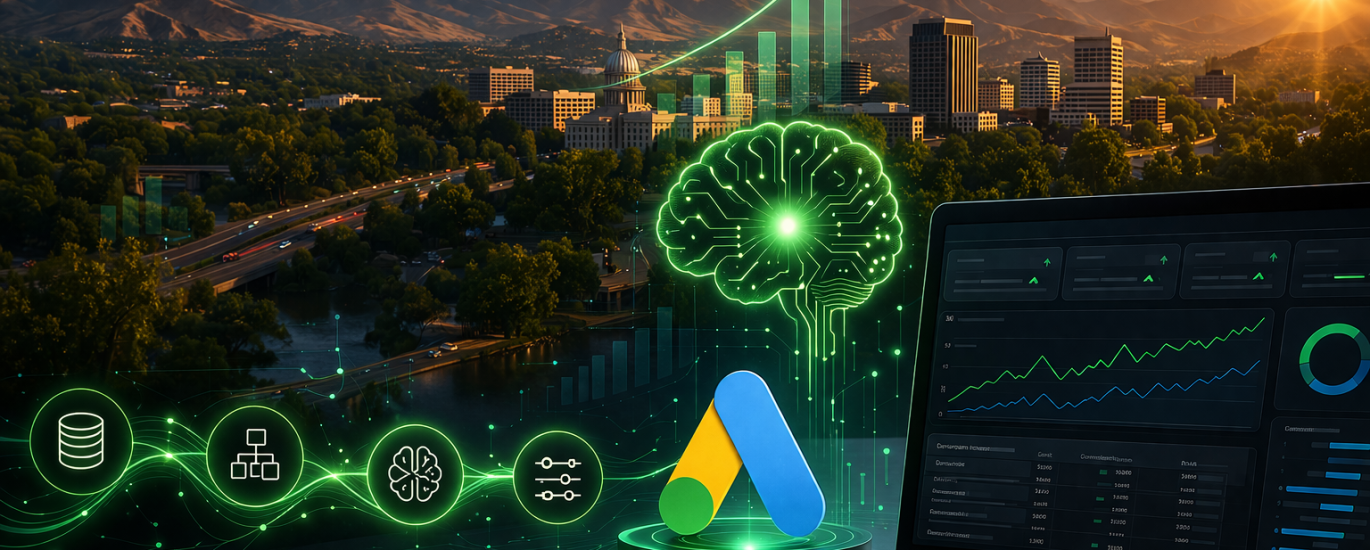
If your campaigns feel unpredictable, it’s not an ads problem—it’s a system failure. Boise Google Ads optimization only works when AI is controlled by structure, not guesswork.
Most Boise businesses don’t lack traffic. They lack infrastructure that converts it.
This Isn’t an Ads Service. It’s an Operating System.
Legacy Engine doesn’t manage campaigns. We install systems.
Learn more about how our systems work on our About Us page.
Legacy Engine Ads OS™ = A system that turns ad spend into predictable revenue
Because:
- Humans forget
- Agencies guess
- Systems scale
Why Most AI Campaigns Still Fail
AI is not the advantage. Control is.
Across dozens of audited accounts, we consistently see:
- Incomplete or inaccurate conversion tracking
- Fragmented campaign structures
- Weak or unclear offers
- Poor-quality data signals
AI doesn’t fix this—it scales it.
The Legacy Engine Ads OS™ Framework for Boise Google Ads Optimization
This is the system behind predictable performance.
1. Signal Layer (Data Control)
Everything starts here.
- Conversion tracking (calls, forms, revenue)
- Event prioritization
- Clean attribution
If this breaks, your entire campaign becomes unreliable.
2. Structure Layer (Campaign Architecture)
Before automation, we define:
- Campaign segmentation by intent
- Keyword mapping
- Audience layering
No overlap. No wasted spend. No confusion.
3. Automation Layer (AI Execution)
Now AI earns its role:
- Smart bidding (tCPA / tROAS)
- Responsive ad testing
- Audience expansion
👉 Automation only works after clean inputs.
4. Control Layer (Human Leverage)
This is where real performance is driven.
We actively manage:
- Budget allocation
- Search term pruning
- Offer positioning
Automate the 80%. Control the 20%.
The Optimization Loop (Runs Weekly)
Every campaign improves through this cycle:
- Observe friction
- Map breakdowns
- Simplify structure
- Deploy automation
- Reallocate spend
There’s always a faster, cleaner path to performance.
Where Boise Businesses Lose Money in Google Ads
If your results are inconsistent, you’re not alone.
Common failure points:
- AI running without enough data
- Broad targeting with no guardrails
- No funnel after the click
- No feedback loop
Result: Spend increases. Revenue stays flat.
Proof Pattern: What Changes After System Installation
Across dozens of audited accounts, we consistently see:
- Cost per lead drop after restructuring inputs
- Conversion rates increase with clearer funnels
- AI performance stabilize once signal quality improves
Not because of better ads—
Because the system starts working.
When NOT to Use AI Bidding
AI is conditional.
Avoid automation if:
- You generate fewer than 30 conversions per month
- Conversion tracking is unreliable
- Your offer is not converting
Manual control will outperform automation in these cases.
You don’t start with AI. You earn it.
This Is Bigger Than Ads
Ads don’t convert. Systems do.
Your growth engine should connect:
- Traffic → Landing Page → CRM → Follow-Up
This is where Content Marketing and Web Design become critical—they complete the system, not just support it.
Before You Scale, Fix This First
Ask yourself:
- Is tracking accurate and complete?
- Is cost per lead stable?
- Is your funnel converting consistently?
If not, scaling will multiply inefficiency.
Install the System. Then Scale It.
If your Google Ads aren’t predictable, you don’t have a marketing problem—you have a systems failure.
We don’t tweak campaigns.
We build infrastructure that compounds.
👉 Contact Us and we’ll map your system, expose the leaks, and show you exactly what to fix—fast.
FAQs
What is Boise Google Ads optimization?
It’s the process of improving ad performance using structured systems, clean data, and controlled AI execution.
What is the Legacy Engine Ads OS™?
It’s a four-layer system that transforms Google Ads into a predictable revenue engine using data, structure, automation, and control.
Is AI bidding better than manual bidding?
Only when supported by strong data and structure. Otherwise, manual bidding often performs better.
Why are my Google Ads inconsistent?
Most campaigns lack proper tracking, structure, and feedback systems, leading to unstable performance.
How do I know if my campaign is ready to scale?
If your cost per lead is stable and your tracking is accurate, your campaign is ready for scaling.