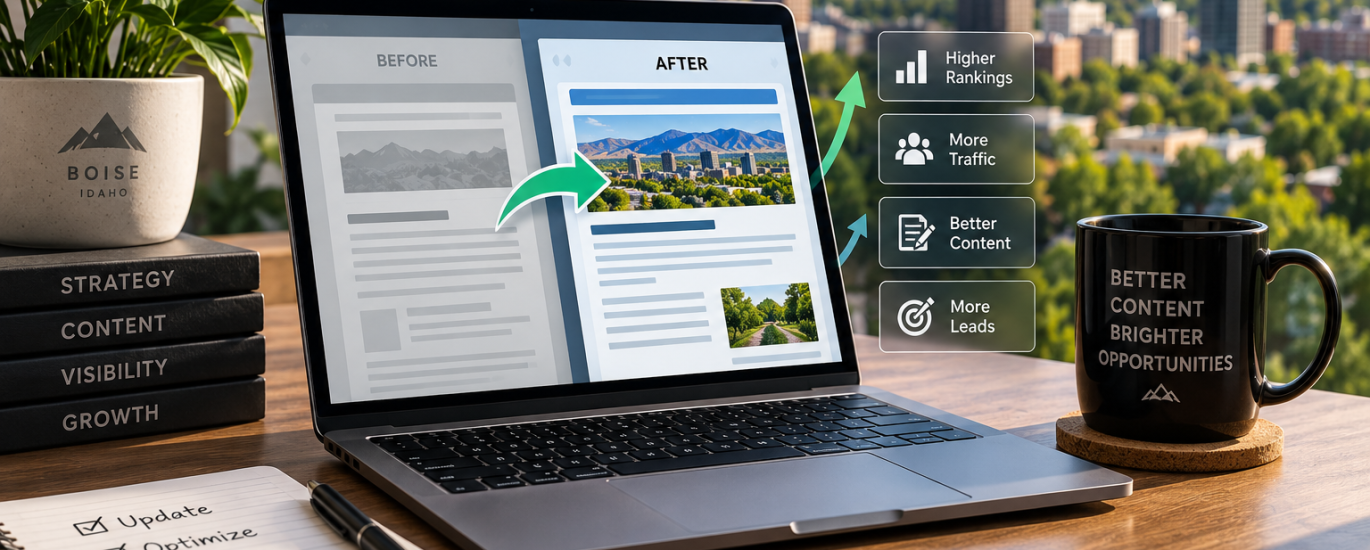
Publishing new content is important. However, older content shouldn’t be ignored once it goes live.
A Boise SEO content refresh gives service businesses an opportunity to improve existing pages, update outdated information, strengthen internal links, and keep useful content aligned with current customer searches.
Instead of treating every blog as a one-time asset, businesses can build a system for continuously improving the content they already own.
What Is an SEO Content Refresh?
A content refresh means reviewing an existing page and improving it where necessary.
It doesn’t always require rewriting the entire article.
A refresh might include:
- Updating outdated information
- Expanding thin sections
- Improving headings
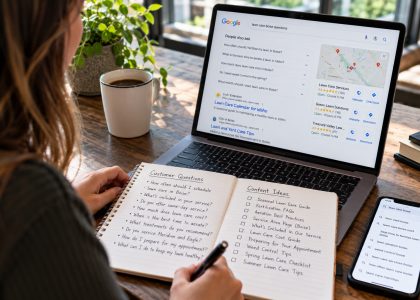
- Answering additional customer questions
- Adding relevant internal links
- Improving calls to action
- Updating service information
- Removing irrelevant content
- Improving local relevance
The goal is to make an existing asset more useful—not simply change words to make it look new.
Why Boise SEO Content Refreshes Matter
Service businesses change over time.
Your customers’ questions can change too.
Meanwhile, an article published months or years ago may no longer represent your best information.
For example, an older blog could mention a service you no longer offer.
Another article might generate search traffic but provide no clear path toward the relevant service page.
A scheduled refresh gives you an opportunity to find and fix those gaps.
Don’t Automatically Replace Older Content
Businesses sometimes assume that more content always means better SEO.
Therefore, they continue publishing new articles while ignoring pages already attracting visitors.
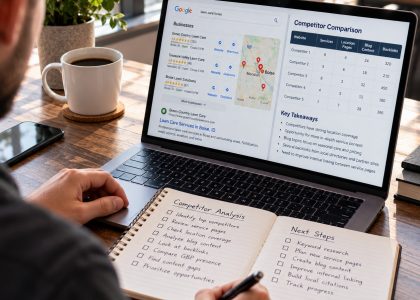
Before creating another article around a similar topic, examine what already exists.
Ask:
- Does an existing page target this search intent?
- Is that page still accurate?
- Could it answer the question more completely?
- Does it connect to the appropriate service?
- Is there an opportunity to improve it?
Sometimes improving an existing page makes more strategic sense than creating another competing page.
Find Content With the Best Refresh Opportunities
Not every page deserves equal attention.
Start with content that has a clear business purpose.
Pages With Existing Search Visibility
An article already appearing in search may have a stronger foundation than starting from zero.
Look for opportunities to make it more complete and useful.
Pages With Outdated Information
Old statistics, services, links, offers, and business details can reduce the usefulness of a page.
Update or remove them.
Pages With Traffic but Few Leads
Traffic without action deserves investigation.
The page may need:
- A stronger CTA
- Better service connections
- Clearer internal links
- Improved search intent alignment
- A better next step
Remember: traffic is not the final objective.
Connect Refreshed Content to Service Pages
One of the most valuable improvements can be surprisingly simple.
Give the reader somewhere relevant to go next.
For example, a Boise homeowner reading an educational article about a service should be able to reach the appropriate service or location page naturally.
Internal links can connect:
Blog → Service Page → Local Landing Page → Contact Opportunity
However, don’t insert links simply for SEO.
The link should help the reader continue their journey.
Refresh Local Relevance Carefully
A Boise-focused article should provide more than repeated mentions of “Boise.”
Look for opportunities to improve genuine local usefulness.
That might include:
- Relevant service-area information
- Boise-specific customer questions
- Treasure Valley considerations
- Links to appropriate location pages
- Updated local examples
However, avoid adding geographic references where they don’t contribute anything meaningful.
Local SEO requires relevance, not city-name stuffing.
Use Refreshes to Strengthen Content Clusters
Individual articles become more valuable when they’re connected strategically.
Imagine a service business has:
- A main service page
- A Boise location page
- Several educational articles
- FAQ content
- Supporting service pages
Refreshing those articles creates an opportunity to improve how everything connects.
That strengthens the website as a system rather than treating every article as an isolated piece of content.
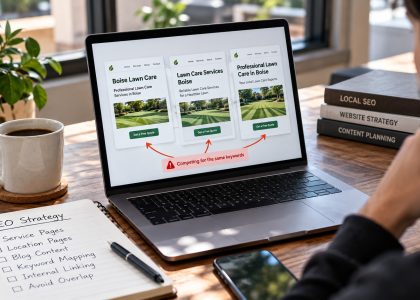
Content Refreshes Can Reduce Topic Overlap
Publishing consistently can eventually create another problem:
multiple pages competing around nearly identical subjects.
For example, a business might publish separate articles answering essentially the same customer question.
Instead of creating a fourth version, review the existing content.
You may decide to:
- Improve the strongest page
- Consolidate overlapping information
- Redirect an unnecessary page when appropriate
- Differentiate the search intent
- Strengthen internal links
This creates a cleaner content architecture.
Build Content Refreshes Into Your Publishing System
The biggest mistake is relying on someone to remember which articles need attention.
Instead, create a repeatable process.
For example:
Publish → Measure → Review → Identify gaps → Refresh → Re-measure
That approach fits Legacy Engine’s operating principle of Relentless Optimization: systems should evolve to become smarter, leaner, and more autonomous over time.
Measure Business Outcomes After the Refresh
Don’t judge a content refresh only by whether a keyword moved several positions.
Review broader performance.
Track metrics such as:
- Organic impressions
- Search clicks
- Relevant traffic
- Internal link clicks
- Calls
- Form submissions
- Qualified leads
- Conversions
A ranking improvement is useful.
A ranking improvement that produces qualified business opportunities is more valuable.
Legacy Engine’s philosophy reinforces this distinction: “Rankings mean nothing without revenue.”
How Legacy Engine Approaches SEO Content
Legacy Engine’s Local SEO system includes weekly SEO content publishing alongside Google Business Profile optimization, local landing pages, citations, and link building.
Those components should support each other.
New articles can expand topical coverage.
Existing articles can be improved.
Internal links can connect informational searches to commercial pages.
Local landing pages can capture service-and-location intent.
The result is a connected Local SEO system rather than an endless stream of disconnected blog posts.
Learn more About Legacy Engine and its approach to Local SEO for service-based businesses.
Make Existing Content Work Harder
You don’t always need another page.
Sometimes you need to make a good page better.
Audit what already exists. Identify valuable opportunities. Improve weak sections. Strengthen internal connections. Then measure what happens.
Publish consistently—but optimize relentlessly.
Ready to build a more systematic approach to Local SEO content? Contact Us to connect with Legacy Engine.
Frequently Asked Questions
What is an SEO content refresh?
An SEO content refresh is the process of reviewing and improving an existing webpage or article to make it more accurate, useful, relevant, and connected to current business goals.
How often should Boise businesses refresh SEO content?
There is no universal schedule. Prioritize pages based on performance, outdated information, business importance, and opportunities for meaningful improvement.
Should I update an old article or publish a new one?
If an existing article already addresses the same search intent, improving it may be more useful than publishing another highly similar page.
What should be updated during a content refresh?
Review accuracy, headings, useful information, internal links, calls to action, local relevance, service details, and customer questions.
How do content refreshes fit into Local SEO?
They help maintain useful content while strengthening connections between articles, services, local landing pages, and other parts of your Local SEO strategy.