A business can publish consistently and still miss valuable search opportunities.
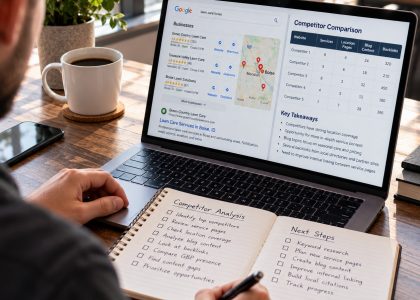
Boise Local SEO content gaps happen when potential customers search for relevant services, locations, or questions that your website does not adequately address.
For Boise service businesses, finding these gaps can reveal opportunities for new articles, service pages, and local landing pages. The goal isn’t to publish more for the sake of volume. It’s to build content around searches that can contribute to real business growth.
What Is a Local SEO Content Gap?
A content gap is a relevant topic or search intent that your website doesn’t currently cover well.
For a local service business, gaps can exist around:
- Core services
- Specific service variations
- Customer questions
- Service areas
- Nearby cities
- Problems customers need solved
- Buying and hiring questions
- Supporting educational topics
For example, a company may have an excellent Boise service page but nothing addressing customers searching for that service in another market it legitimately serves.
That’s a geographic content gap.
Why Boise Businesses Should Look for Content Gaps
Your website doesn’t need to rank for every possible search.
It should cover the searches most closely connected to your customers and services.
Imagine a Boise service company offers five important services.
Its website only has detailed content for two.
That leaves three services poorly represented in organic search.
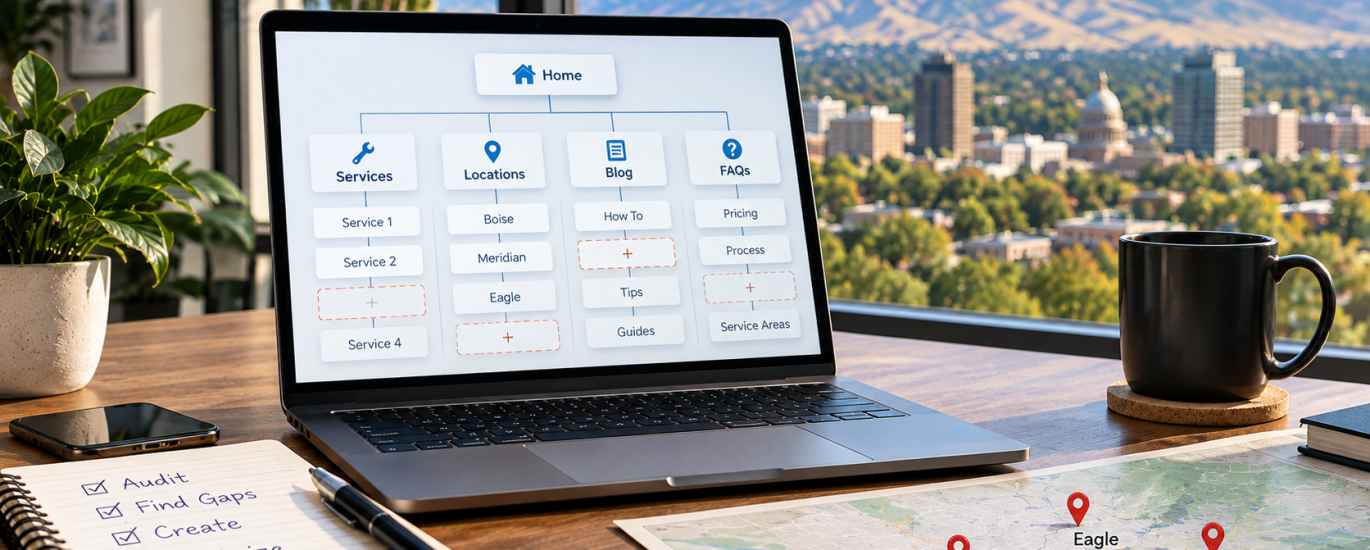
Similarly, a business serving Boise, Meridian, Eagle, and Nampa may have content focused almost entirely on Boise.
The opportunity isn’t necessarily another generic blog. It may be filling the missing part of the website’s search footprint.
Start With Your Most Important Services
Before searching for clever blog topics, review what your business actually sells.
Create a list of your primary services.
Then determine whether each service has a strong, useful destination on your website.
Ask:
- Does this service have a dedicated page?
- Is the page substantial enough to help customers?
- Does it explain the problem being solved?
- Does it answer important questions?
- Can visitors easily request the service?
- Is it connected to relevant supporting content?
If an important revenue-generating service barely exists on your website, that’s a higher priority than another unrelated article.
Find Geographic Content Gaps
Service-based businesses often operate beyond one city.
However, their websites don’t always reflect that footprint.
Consider the markets your business actually serves.
Then compare those markets with your existing website structure.
You may uncover opportunities for Service + City pages around legitimate combinations such as:
- Core Service + Boise
- Core Service + Meridian
- Core Service + Eagle
- Core Service + Nampa
However, don’t create location pages simply to increase page count.
Each market should represent a real service area and business opportunity.
Look at Customer Questions
Your customers can reveal content gaps better than a brainstorming session.
Pay attention to questions asked during:
- Phone calls
- Estimates
- Sales conversations
- Email inquiries
- Appointments
- Customer support
- Google Business Profile interactions
If prospects repeatedly ask the same question, your website may need to answer it.
For example:
“How much does this service cost?”
“How long does it take?”
“Do you serve my neighborhood?”
“What’s included?”
Those questions can become FAQs, supporting articles, or improvements to existing service pages.
Separate Informational and Commercial Search Intent
Not every searcher is ready to hire someone.
Some people want information.
Others are actively searching for a provider.
Your content structure should recognize the difference.
Informational Content
These searches often involve questions.
Examples include:
- How does a service work?
- When should I hire a professional?
- What causes a specific problem?
- How can I prepare for an appointment?
Educational SEO content can address these searches.
Commercial Content
These searches are closer to a transaction.
They often involve:
- A specific service
- A provider
- A location
- Pricing
- Availability
Service pages and local landing pages should usually carry more of this responsibility.
A strong SEO system needs both discovery and conversion content.
Don’t Create New Pages Before Checking Existing Content
A content gap isn’t always solved with a new URL.
Sometimes the information exists but needs improvement.
Before publishing another page, determine whether you should:
- Create something new
- Expand an existing page
- Refresh an older article
- Add an FAQ section
- Improve internal links
- Consolidate overlapping pages
This prevents unnecessary content duplication.
It also keeps your website architecture cleaner.
Use Internal Links to Close Structural Gaps
Content can exist and still be disconnected.
For example, your website might have an excellent service page and several relevant articles.
However, none of those articles link to the service.
That’s a structural opportunity.
Relevant internal links can connect:
Educational Content → Service Page → Local Landing Page → Conversion
This gives visitors a logical journey through the website.
In addition, it helps prevent useful pages from becoming isolated.
Build a Content Gap Map
Instead of selecting topics randomly each week, create a simple content map.
Organize opportunities into categories such as:
| Content Area | Example Opportunity |
|---|---|
| Services | Missing core service page |
| Locations | Missing Service + City page |
| Questions | Frequently asked customer question |
| Supporting Content | Educational blog topic |
| Conversion | Missing CTA or service connection |
| Existing Content | Page requiring expansion |
Then prioritize each opportunity according to business value.
Prioritize Revenue-Relevant Gaps
Search volume shouldn’t make every decision.
A lower-volume topic directly connected to a profitable service can be more valuable than a broad topic generating thousands of irrelevant visitors.
Ask:
Does this content help attract someone we actually want as a customer?
That question reflects Legacy Engine’s philosophy that rankings alone aren’t the objective. The system should ultimately connect visibility with business outcomes.
Turn Content Gap Analysis Into a Recurring System
Your website will never be permanently finished.
New services appear.
Markets expand.
Customers ask new questions.
Existing pages become outdated.
Therefore, content gap analysis should become a recurring process.
A simple workflow could be:
Audit → Identify gaps → Prioritize → Build → Publish → Measure → Optimize
That fits Legacy Engine’s operating approach: observe friction, map the system, simplify, optimize, and continue improving it over time.
How Legacy Engine Builds SEO Content Around a System
Legacy Engine’s Local SEO approach connects multiple components rather than treating blog publishing as an isolated marketing activity.
That includes:
- Google Business Profile optimization
- Local landing pages
- Citations
- Link building
- Weekly SEO content publishing
Content gap analysis helps determine what should be built next.
A missing commercial search may require a local landing page.
An unanswered customer question may require supporting SEO content.
A weak existing article may need optimization instead of replacement.
That’s the difference between publishing randomly and building an intentional search system.
Learn more About Legacy Engine and its approach to Local SEO for service-based businesses.
Stop Guessing What to Publish Next
Your next SEO topic shouldn’t come from an empty content calendar.
Start with the gaps.
Review your services. Map your locations. Study customer questions. Examine existing pages. Then identify what’s missing between the searches customers make and the content your website provides.
Build the missing pieces that matter to the business.
Ready to develop a more structured Local SEO system? Contact Us to connect with Legacy Engine.
Frequently Asked Questions
What is a Local SEO content gap?
A Local SEO content gap is a relevant service, location, question, or search intent that a business website does not currently address effectively.
How can Boise businesses find content gaps?
Review core services, service areas, customer questions, existing website pages, internal links, and search opportunities related to actual business offerings.
Does every content gap require a new blog?
No. Some gaps are better solved by improving an existing page, adding an FAQ, strengthening internal links, or creating a service or location page.
Are location pages considered part of content gap analysis?
Yes. Businesses serving legitimate markets without relevant location content may have geographic gaps in their website strategy.
How should businesses prioritize SEO content gaps?
Prioritize gaps based on relevance to core services, customer intent, geographic importance, conversion potential, and overall business value.