When you’re trying to grow your business online, creating more website pages can seem like the right move. More service pages, more city pages, and more blog posts should mean more opportunities to appear on Google, right?
Not necessarily.
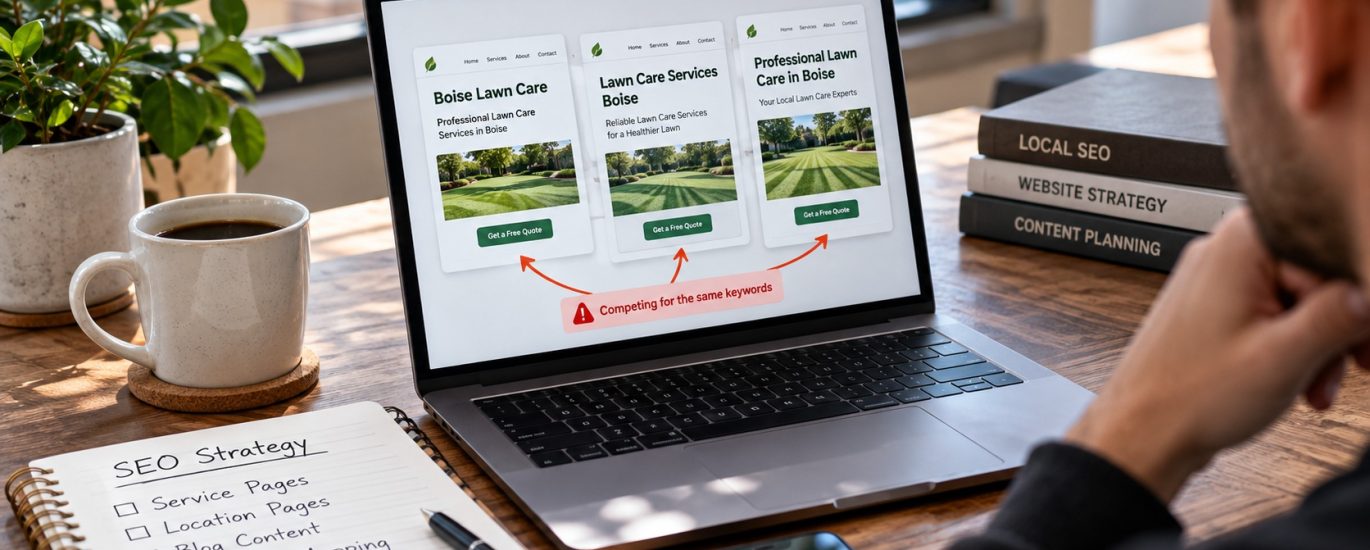
Boise local SEO keyword cannibalization can become a problem when several pages on your website target the same customer search without offering meaningful differences.
For Boise service businesses, this often happens as websites grow without a clear content strategy. What starts as an effort to improve local visibility can create overlapping pages, confusing navigation, and unnecessary SEO work.
The good news? You don’t necessarily need fewer pages. You need a better plan for the pages you publish.
What Is Local SEO Keyword Cannibalization?
Keyword cannibalization happens when multiple pages on the same website compete for similar searches and serve essentially the same purpose.
For example, imagine a Boise lawn care company with these three pages:
- Boise Lawn Care Services
- Professional Lawn Care in Boise
- Best Lawn Care Company in Boise
Each page might target slightly different keywords. However, if they all describe the same services and answer the same questions, they may offer little additional value.
This creates unnecessary overlap.
Important: Using similar keywords across different pages is not automatically harmful. The concern is whether those pages serve the same search intent without providing distinct information.
A general pest control page and a rodent control page, for example, can both be valuable because they address different customer needs.
Why Keyword Cannibalization Matters for Boise Service Businesses
Boise is home to businesses competing for customers across lawn care, pest control, dog training, pool maintenance, and other local services.
As these companies expand their websites, they often add pages for new services, neighborhoods, and nearby cities.
Without a structured approach, some pages may begin overlapping.
Here are four reasons that matters.
1. Customers May Struggle to Find the Right Information
Your website should make it easy for visitors to understand what you offer.
When several pages contain nearly identical descriptions, customers may have trouble identifying the most relevant one.
Clear service pages create a better experience and help visitors move toward contacting your business.
2. Your Internal Linking Becomes Less Focused
Internal links connect related pages throughout your website.
For example, an article about lawn fertilization should naturally direct interested readers to the relevant lawn fertilization service page.
However, if your website contains several similar service pages, links may point to different destinations without a clear reason.
A more organized structure makes those connections easier to maintain.
3. You Spend More Time Maintaining Similar Content
Every website page requires attention.
Service details change. Business information needs updating. Content becomes outdated.
Maintaining several nearly identical pages creates extra work without necessarily improving the customer experience.
4. Measuring SEO Performance Becomes More Complicated
When multiple pages target similar searches, evaluating performance can become harder.
You may find impressions and clicks distributed across several URLs.
That doesn’t automatically mean Google is penalizing your website. However, it may indicate that your content structure deserves a closer look.
The goal is to make every important page useful, distinct, and easy to understand.
How Keyword Cannibalization Happens on Local Service Websites
Most businesses don’t intentionally create overlapping pages.
The problem usually develops gradually.
Creating a Page for Every Keyword Variation
A business researches keywords and discovers several phrases:
- Pest control Boise
- Boise pest control company
- Professional pest control Boise
- Pest control services in Boise
These searches may reflect essentially the same customer need.
Instead of creating four separate pages, one comprehensive pest control service page may be more appropriate.
The page can naturally address several relevant keyword variations while clearly explaining the service.
Publishing Nearly Identical City Pages
Many Boise service businesses also serve nearby communities such as Meridian, Eagle, Kuna, and Garden City.
Creating location-specific pages can make sense when those markets are genuinely served.
However, publishing the same content repeatedly and changing only the city name provides limited value.
Useful location pages should accurately explain where services are available and include meaningful information for customers.
Publishing Blogs That Repeat Existing Service Pages
Blog articles and service pages should complement each other.
For example:
Service page: Boise Lawn Fertilization Services
Blog article: When Should Boise Homeowners Schedule Lawn Fertilization?
The service page explains what the company offers.
The blog answers an educational question.
Both pages have a clear purpose.
However, publishing several articles that repeat the same service description without adding useful information can create unnecessary content overlap.
The Difference Between Similar Keywords and Similar Search Intent
One of the biggest misconceptions about keyword cannibalization is that every keyword needs its own page.
That isn’t how a useful website should be organized.
A customer searching for “lawn care Boise” may want to hire a local provider.
Someone searching for “when to fertilize a lawn in Boise” wants information before making a decision.
Those searches represent different intentions.
Here’s how that distinction can guide your website:
| Customer search | Likely intent | Best page type |
|---|---|---|
| Pest control Boise | Find a provider | Main service page |
| Rodent control Boise | Find a specific service | Dedicated service page |
| Pest control Meridian | Check local service availability | Relevant location page |
| Signs of rodents in an attic | Learn about a problem | Educational blog |
| Contact a pest control company | Reach a provider | Contact information |
These are examples, not verified keyword recommendations. Actual search results and keyword research should guide your final content decisions.
Build pages around what customers need, not every variation of a keyword.
How to Identify Keyword Cannibalization on Your Website
Before changing your website, determine whether overlapping pages actually exist.
A simple content review can help.
Review Your Existing Pages
Start by listing your most important website URLs.
Include service pages, location landing pages, and blog articles.
Then identify the primary purpose of each page.
Ask yourself:
- What service or topic does this page cover?
- Which customers is it designed to help?
- Does another page answer the same question?
- What makes this page different?
If two pages serve essentially the same purpose, they may deserve further review.
Check Google Search Console
Google Search Console provides information about how your website appears in Google Search.
You can review which pages receive impressions and clicks for relevant queries.
For example, you might discover that two Boise service pages appear for similar searches.
That observation alone doesn’t prove a problem.
However, it provides a starting point for comparing their content and purpose.
Learn more through Google Search Console’s official documentation.
Compare the Content
Open the pages you’re concerned about.
Review their headings, service descriptions, customer questions, and calls to action.
If the information is nearly identical, consider whether both pages are necessary.
If each page provides distinct value, keeping them separate may be appropriate.
How to Fix Local SEO Keyword Cannibalization
Once you’ve identified unnecessary overlap, the next step is choosing the right solution.
Not every situation requires deleting a page.
Combine Pages That Serve the Same Purpose
If two pages provide essentially identical information, consolidating them may create a stronger resource.
For example, a Boise lawn care company might combine two overlapping general service pages into one comprehensive page.
Before making changes:
- Review both pages’ content and performance.
- Identify the most appropriate primary URL.
- Preserve useful information from each page.
- Update relevant internal links.
- Redirect retired URLs when a suitable replacement exists.
- Monitor performance after the change.
Avoid deleting pages without reviewing their existing value.
Make Similar Pages More Distinct
Sometimes both pages deserve to exist.
A pest control company might offer general pest control, rodent control, and commercial pest control.
Although these services share related terminology, they address different customer needs.
Each page should explain its specific service, process, and customer expectations.
Improve Your Internal Linking
Internal links should connect related information naturally.
For example, an article about rodent warning signs can direct readers to the company’s rodent control service page.
That connection helps customers move from understanding a problem to exploring a relevant solution.
Update Existing Content Instead of Publishing Another Article
Before creating a new blog, review what you’ve already published.
You may discover that an existing article needs more complete information rather than a competing article.
Adding useful explanations, updated details, and relevant internal links can improve the resource without expanding the website unnecessarily.
Why a Clear Local Landing Page Framework Matters
For Boise service businesses, website structure becomes increasingly important as services and geographic coverage expand.
A well-planned Local Landing Page Framework helps organize content around real customer needs.
For example, a pest control company might maintain:
- A main pest control service page
- Dedicated pages for distinct pest control services
- Relevant location pages for areas it actually serves
- Educational blogs answering common customer questions
Each page should have a defined role.
Service pages explain offerings.
Location pages communicate genuine availability.
Blog articles provide helpful information.
This structure also makes it easier to identify where new content belongs.
The goal is not to create as many pages as possible. It’s to create the right pages for the right searches.
How Weekly SEO Content Publishing Fits Into the Strategy
Consistent publishing can help a website address more customer questions over time.
However, publishing without reviewing existing content can lead to repetition.
Before adding another article, consider whether it introduces a genuinely new topic or improves an existing resource.
A structured publishing process should include:
- Reviewing previously published content
- Identifying relevant customer questions
- Researching search intent
- Selecting the appropriate page format
- Planning contextual internal links
- Monitoring results over time
This keeps content development focused on useful opportunities rather than unnecessary page volume.
How to Prevent Keyword Cannibalization Before It Starts
Preventing overlapping pages is usually easier than reorganizing an established website.
Before publishing a new service page, location page, or blog article, ask three questions.
Does This Page Serve a Different Purpose?
Identify the specific customer need the page will address.
If another page already answers that need, consider improving the existing content.
Does This Page Add Meaningful Information?
A new page should offer more than a different headline or keyword variation.
It should help customers understand a distinct service, location, or question.
Does This Page Fit the Existing Website Structure?
Every new page should have a logical place within your website.
Consider how customers will discover it and which existing pages should link to it.
These simple decisions help prevent unnecessary content overlap as your website grows.
How Legacy Engine Helps Boise Businesses Build Better SEO Structure
Legacy Engine helps service-based businesses develop a more organized approach to Local SEO.
Instead of treating every new page as an isolated project, its services support a connected local search strategy.
Local Landing Page Framework: Organizes relevant service and location pages around actual business coverage.
Weekly SEO Content Publishing: Develops useful content that addresses customer questions and supports existing website resources.
Link Building & Citations: Supports a consistent local presence through relevant links and accurate business information.
Google Business Profile Optimization: Helps maintain accurate service and business details across Google Search and Maps.
Together, these services support a more structured online presence.
For Boise business owners, that means focusing on content that serves a purpose rather than publishing pages simply to increase website size.
Build a Stronger Local SEO Website With a Clear Strategy
More pages can create more opportunities, but only when those pages provide genuine value.
For Boise service businesses, unnecessary keyword overlap can complicate website navigation, content maintenance, and SEO analysis.
A clear content structure helps ensure that each important page answers a specific customer need.
Before publishing another landing page or blog article, review what already exists.
Identify where useful information is missing.
Then create content that fills those gaps without unnecessarily repeating existing pages.
Better rankings aren’t guaranteed by more pages. A stronger website starts with better organization.
Learn more About Legacy Engine and its Local SEO approach for service-based businesses.
Ready to build a more organized local search presence? Contact Us to discuss your website and SEO strategy.
Frequently Asked Questions
What is Boise local SEO keyword cannibalization?
Boise local SEO keyword cannibalization occurs when multiple website pages target essentially the same local search intent without offering meaningful differences in value.
Does keyword cannibalization always hurt Google rankings?
No. Pages can legitimately appear for similar searches. Potential issues arise when they unnecessarily duplicate information or lack distinct purposes.
Should Boise businesses combine similar service pages?
Sometimes. Pages addressing the same customer need may benefit from consolidation. However, pages covering different services or locations may deserve to remain separate.
How can I find keyword cannibalization on my website?
Review your existing pages, compare their search intent, and examine performance in Google Search Console. Look for unnecessary content overlap.
How can a Local Landing Page Framework help?
A structured framework helps businesses organize service and location pages around real customer needs. This reduces unnecessary duplication and supports clearer website navigation.